

So, you’re feeling uncomfortable and frustrated. You have this feeling that something needs to
change, but you can’t really put your finger on what exactly needs to change. All you know is that you don’t like how
things are. All aspects of your life
feel difficult and overwhelming. Perhaps
it has something to do with your job, or your relationship with your
significant other. Perhaps it’s your
family, your financial situation, or maybe you’re just not having any fun. You’re not sure, and before you decide to
make a change, you need to understand what exactly needs to change.
To overcome this feeling, it helps to take some time out to reflect
on your life as a whole; identify what you want to change; and then how you’re
going to change it.
The
first session with coaching clients is always focused on this. Some clients come in with an idea of what
they want to change and others don’t.
Regardless of this, we start with the Life Wheel Exercise which helps
the client get some clarity on the one area that they should be working on.
In this blog, I’ll walk you through the Life Wheel exercise to
help you do the same.
Step 1: Figure Out What It Is That You Need To Change
In their first coaching session, clients evaluate their life as a
whole using the Life Wheel. This is a
general reflection of the various areas of our lives.
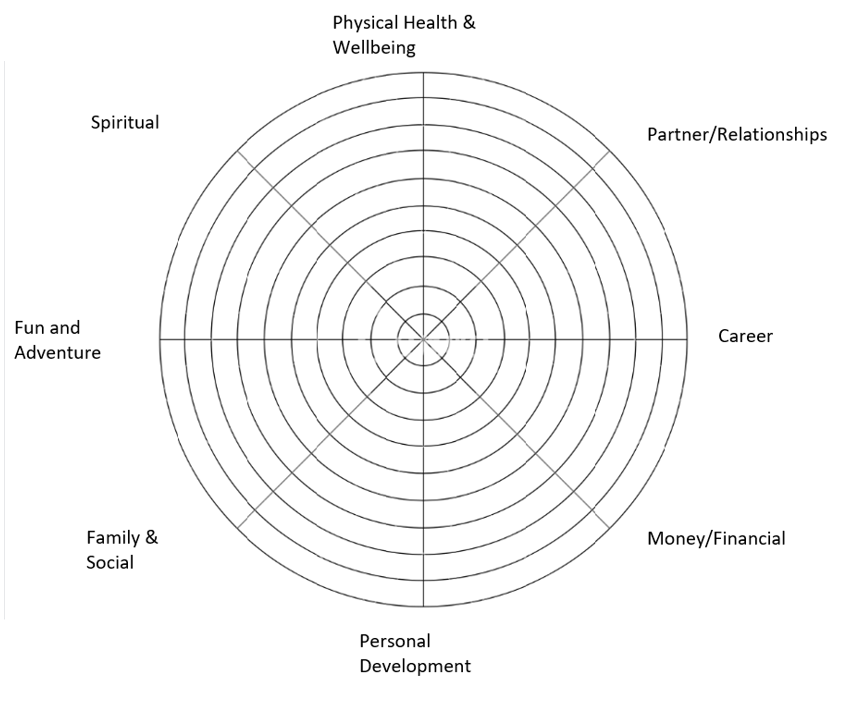
Looking at each area, rate how you feel about that area on a scale from 1 to 10.
1 means you’re very unhappy with that area and is reflected at the centre of the wheel.
10 means that everything is going well in that area and is reflected on the circumference of the wheel.
This will give you a reflection on the area that you would like to
work on. Focus on the area that you have
rated lowest.
Step 2: Figure Out What Would Be Ideal
Once you know which area you need to work on, you need to identify what would be ideal – what you want this area of your life to look like.
Some questions to help you to brainstorm this are:
- If everything was going well and I had all the resources and time I needed, what would be happening in this area?
- What would I have?
- What would I be doing every day?
- What am I excited about?
- How am I feeling?
- When will this happen?
Now that you know what the ideal would be like, it’s time to write out your goal. Write out your goal in a paragraph, as if you’re telling yourself a story.
Imagine it’s the day that you’ve achieved the goal. Write down what is happening and what has changed in the present tense.
Once you've written your goal, step away from it for a while and then review it. Make any changes that you feel you need to make.
Step 3: Break It Down!
Now that you know what you want to change and how it would need to change, you might be thinking “This is a LOT! How am I going to do this?”
Taking into consideration the deadline that you’ve set for
yourself, break down your goal into monthly milestones. Be practical, but don’t give yourself too
much time in which to achieve your goal.
If there’s no sense of urgency, you will find yourself getting distracted. Write down 6 things that need to happen in
the next 6 months.
Step 4: Break It Down Again!
Again, you’re going to look at these milestones and think “This is a LOT! How am I going to do this?”
Break down your milestones into smaller steps. List 4 things that need to happen to complete each milestone. Now you have 1 thing to complete each week.
Add these action steps to your to-do list, or your calendar. Set reminders to keep you on track. At the beginning of each week, check in on
what steps you need to complete and make the time to do them.
Step 5: Be Kind To Yourself
Making the change won’t be easy. You’ll have to make a conscious effort to complete the steps that you need to. Sometimes, you will fail and that’s ok. Learn from mistakes and failures and use those lessons to help you as you progress.
When you do succeed, celebrate your wins no matter how small.
Use Your Goal As Your Compass
I’ll say it again. Making a change will be difficult.
Sometimes you may get distracted by other shiny and new things. Always use your goal as your compass and ask yourself “Is this going to help me achieve my goal?”
When doubt and fear creep in (and they will) – go back to your goal and remember why you set it in the first place.
Create habits around your goal. Replace habits that don’t support you in achieving your goal with habits that do.
Remember that change takes time and patience, so be kind to
yourself and celebrate your progress along the way.
If you’re unhappy with the way your life is and don’t
know how to change it, get in touch for a free call to see how coaching can
help you. What do you have to lose?